Accustomed to work in network, followers of the social media, for many people, the generation Y is the one which is going to allow the social business to take off. Yet, when I look at the key age « evangelists » social business or developers of collaborative work or the use of social media that I encounter in companies, they are mostly X. So is Generation Y the messiah of 2.0 expected ?
Archives de catégorie : Post in english
Social media : Can the french pigeons movement be reproduced
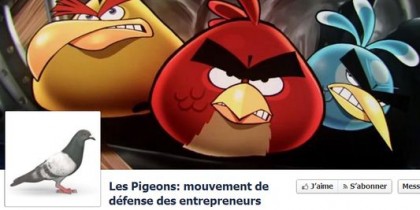
Every year there are breaking news on social media, that becomes case study, as Nestle. The french pigeons movement seem to get in the way. You must have heard about it, anglo-saxon press relayed it. Anyway, a quick summary before seeing further. Continuer la lecture
Management 2.0 and worker engagement
Engagement is fashionable concept, but most of al it’s a business management concept.
Employee Engagement is a measurable degree of an employee’s positive or negative emotional attachment to their job, colleagues and organization which profoundly influences their willingness to learn and perform at work
So behind this concept, what about social business ?
Social business : digital smuggler, does it make sense ?
Yesterday I was at a conference about HR2.0 as a speaker, where I was discussing notably with Claude Super, Franck La Pinta, Didier Baichere about evangelism and social business, HR2.0.
Being speaker at seminars, conferences, or through our blogs and more broadly by our writings, we have a role of digital smuggler, about the impact that can have the use of these social tools in organizations.
Social Business and Sociology of Organizations
Nothing new when you say that management is more important than the tools, even if they are social. That’s why social business is more focus on management model than tools. Usually peoples highlights the work of Peter Drucker to talk about management. In France one of our though leader about those question of organization is Michel Crozier.
As noted by the Nobel Prize in Economics in 1978 Herbert H. Simon, every situation is experienced as a specific problem: « What to do? « Each behavior is the best or the least bad solution to the problem in terms of the issues and constraints of the situation, available resources, experiences, information, etc.. Behavior is always rational (even if it seems unreasonable to others) because each player chooses a solution based on its « bounded rationality ».